Saturday, 11 February 2017

A forgotten lesson ...

Aristotle
Aristotle (Metaphysics XIII) on the reification of the mathematical:
'It is said that the objects of mathematics—i.e. numbers and lines and the like—are substances,' and some say moreover 'that the mathematical substances are the only substances.' But conclusions contrary to the truth follow, 'if one supposes the objects of mathematics to exist thus as separate entities. For if they exist thus they must be prior to sensible spatial magnitudes, but in truth they must be posterior; for the incomplete spatial magnitude is in the order of generation prior, but in the order of substance posterior, as the lifeless is to the living ...'
'Grant that they are prior in formula. Still not all things which are prior in formula are prior in substance. For those things are prior in substance which when separated from other things surpass them in the power of independent existence, but those arc prior in formula out of whose formulae the formulae of other things are compounded; and these two properties are not coextensive. For if attributes, such as "moving" or "white," do not exist apart from their substances, the white is prior to the white man in formula, but not in substance. For it cannot exist separately, but is always along with the concrete thing; and by the concrete thing I mean the white man. Therefore it is plain that neither is the result of abstraction prior nor that which is produced by adding determinants posterior; for it is by adding a determinant to the white that we speak of the white man.'

Wednesday, 8 February 2017

Chomsky on today's materialism ...

Chomps
What Kind of Creatures Are We? (Columbia UP, 2016) is Noam Chomsky's latest (and perhaps last-est) word on philosophy's big questions. The final chapter of the book is an exercise in what Aristotelians call philosophy of nature, an intermediary discipline between metaphysics and science. There Chomsky argues that the terms material, physical, natural (et al) are basically meaningless nowadays. (And what, then, is it to be a materialist, a physicalist, a naturalist? Cf. the  posts on Galen Strawson here, here, and here.) See, 'we speak of the "physical" world much as we speak of the "real" truth: for emphasis, but adding nothing' (What Kind of Creatures Are We?, p. 105).
'[T]he notions of body, material, physical are hardly more than honorific designations for what is more or less understood at some particular moment in time, with flexible boundaries and no guarantee that there will not be radical revision ahead, even at its core' (ibid., p. 102).
'[T]he concept "physical facts" means nothing more than what the best current scientific theory postulates, hence should be seen as a rhetorical device of clarification, adding no substantive content' (ibid., p. 125). 
Whatever happened to the 'substantive content'? As metaphysicians of matter, the early modern revolutionaries were mechanists.* What does that mean? Chomsky understands the mechanical as that which 'an artisan could construct' (ibid., p. 91). This is correct, inasmuch as all that's mechanical is (theoretically) constructible, but it doesn't get to the centre of the question. At the centre is this: the early modern understanding of matter (or of that which is material) was dysteleologico-nominal. What does that mean? It's helpful to look back to the later mediæval metaphysics, against which Kepler, Galileo, Descartes (and so on) positioned themselves. For Aristotelian metaphysicians, such as Aquinas and Scotus, the difference between an organism and an artefact is teleologico-essential. That is to say, an organism (an example of physis) has an intrinsic teleology and a substantial form, and is in this sense autotelic; whereas an artefact (a product of techne) has an extrinsic teleology and an accidental form, and is in this sense exotelic. The bisect that's made here isn't at all trivial. Its consequences are both intensive and extensive. (Take an example: the causation manifest in an organism is both immanent and transient—immanent in that it begins with the organism and terminates in the organism for the sake of the organism, to adapt David Oderberg—whereas that manifest in an artefact is transient simpliciter.) But here's the kicker, these teleologico-essential concepts (themselves the centuries-absent 'substantive content') are irreducibly qualitative, and the early moderns argued that the material world is to be understood in a reductively quantitative way. They therefore rejected these concepts as immaterial, nonphysical, supernatural, etc., necessitating substance dualism. The upshot is that, armed with mathematism, techne drove physis out of the cosmos altogether, and God was demoted from actus purus to artifex maximus, a supersmart artificer-demiurge. (Whence Pascal's criticisms of  Cartesianism qua proto-deism, a philosophy which would've liked to do without God, but 'couldn't help allowing him a flick of the finger to set the world in motion.' Cf. Kierkegaard: 'In scientific distraction people made God into a rather stupid God.') There are inferior man-made machines (e.g. levers and pulleys and cathode-ray tubes) and there are superior God-made machines (e.g. molecules and plants and animals)—that's all.†

[Off-piste addendum: 'History is written by the winners.' We're repeatedly told in the textbooks that scientists (qua scientists) discovered that the world was dysteleologico-nominal. But how could that be? No, that the world is thus-and-so was a conceptual decision, not (per absurdum) an empirical discovery.]

Note that we're still mechanists today, inasmuch as we're still dysteleologico-nominal. The atomistic (or corpuscular) push-pull causation, the Cartesian contact mechanics, and so on, gave place to the conclusions of the Newtonian and quantum-theoretic revolutions. But these are internal revolutions, internal to a subsisting mathematism.

What's frustrating is that the same philosophers who tell us that the terms 'material,' 'physical,' 'natural' are empty husks, e.g. Bertrand Russell, try to feed them to us as good eating nonetheless—an aporia. Chomsky picks up on this, noting that when Russell says 'experience is "part of the material of the physical world," ' this means 'no more than "part of the world" ' (ibid., p. 102). Thus Chomsky suggests 'simply dropping the words "matter" and "physical" ' (ibid., p. 105), and that's a start. What comes next?

In the end Chomps himself retires to a mysterianism, believing that there are probably 'ultimate secrets that will ever remain in obscurity, impenetrable to human intelligence' (ibid., p. 127). For 'if we are biological organisms, not angels, much of what we seek to understand might lie beyond our cognitive limits ... There is no reason to believe that humans can solve every problem they pose or even that they can formulate the right questions; they may simply lack the conceptual tools, just as rats cannot deal with a prime number maze' (ibid., pp.104-5). His position is not unlike Pascal's:
'Let us then realise our limitations. We are something and we are not everything ... Our intelligence occupies the same rank in the order of intellect as our body in the whole range of nature. Limited in every respect, we find this intermediate state between two extremes reflected on all our faculties. Our senses can perceive nothing extreme; too much noise deafens us, too much light dazzles; when we are too far or too close we cannot see properly; an argument is obscured by being too long or too short; too much truth bewilders us ... In a word, extremes are as if they did not exist for us nor we for them; they escape us or we escape them.' 
'Such is our true state. That is what makes us incapable of true knowledge or absolute ignorance. We are floating in a medium of vast extent, always drifting uncertainly, blown to and fro; whenever we think we have a fixed point to which we can cling and make fast, it shifts and leaves us behind; if we follow it, it eludes our grasp, slips away, and flees eternally before us. Nothing stands still for us. This is our natural state and yet the state most contrary to our inclinations. We burn with desire to find a firm footing, an ultimate, lasting base on which to build a tower rising up to infinity, but our whole foundation cracks, and the earth opens up into the depth of the abyss.' (Pensée 199)

* 'The label "mechanistic philosophy" or "mechanicism" should be handled with care, as it was not employed by the novatores themselves' (Cees Leijenhorst, The Mechanisation of Aristotelianism, p. 6).

†A difference of degree, not kind; the definition of God-made machines is comparatively compounded (e.g. 'machinam hydraulico-pneumatico-pyriam'). Leibniz: 'An organism is formally nothing other than a mechanism, even if it is more exquisite and divine.' Herr Leibniz would later try to restore full godhead (to the all-too-human demigod of the moderni) by infinitizing the mechanical complexity of God's machines. See, for example, Guido Giglioni's Automata Compared.

Pointer readings ...

Eddington and friends
From Sir Arthur Eddington's The Nature of the Physical World:
'Let us then examine the kind of knowledge which is handled by exact science. If we search the examination papers in physics and natural philosophy for the more intelligible questions we may come across one beginning something like this: "An elephant slides down a grassy hillside…" The experienced candidate knows that he need not pay much attention to this; it is only put in to give an impression of realism. He reads on: "The mass of the elephant is two tons." Now we are getting down to business; the elephant fades out of the problem and a mass of two tons takes its place. What exactly is this two tons, the real subject matter of the problem? It refers to some property or condition which we vaguely describe as "ponderosity" occurring in a particular region of the external world. But we shall not get much further that way; the nature of the external world is inscrutable, and we shall only plunge into a quagmire of indescribables. Never mind what the two tons refers to; what is it? How has it actually entered in so definite a way into our experience? Two tons is the reading of a pointer when the elephant was placed on a weighing-machine. Let us pass on. "The slope of the hill is 60˚." Now the hillside fades out of the problem and an angle of 60˚ takes its place. What is 60˚? There is no need to struggle with mystical conceptions of direction; 60˚ is the reading of a plumb-line against the divisions of a protractor. Similarly for the other data of the problem. The softly yielding turf on which the elephant slides is replaced by a coefficient of friction, which though perhaps not directly a pointer reading is of kindred nature. No doubt there are more roundabout ways used in practice for determining the weights of elephants and the slopes of hills, but these are justified because it is known that they give the same results as direct pointer readings.' 
'And so we see that the poetry fades out of the problem, and by the time the serious application of exact science begins we are left with only pointer readings. If then only pointer readings or their equivalents are put into the machine of scientific calculation, how can we grind out anything but pointer readings? But that is just what we do grind out. The question presumably was to find the time of descent of the elephant, and the answer is a pointer reading on the seconds’ dial of our watch.' 
'The triumph of exact science in the foregoing problem consisted in establishing a numerical connection between the pointer reading on the weighing-machine on one experiment on the elephant and the pointer reading on a watch in another experiment. And when we examine critically other problems of physics we find that this is typical. The whole subject matter of exact science consists of pointer readings and similar indications' (p. 127).

Wednesday, 12 October 2016

There's an old saying ...

When small men cast large shadows, it’s a sure sign that the sun is setting.

Wednesday, 14 January 2015

More isolationism ...

Inasmuch as we've concretised abstractions (mind/body, quality/quantity ...) and literalised metaphors (inner/outer, introspection/extrospection ...), dualism is built into our language. And inasmuch as it is built into our language, a dualistic necessitarianism is generated. 'This is how it has to be,' we say (Philosophical Investigations§112). Thus an early-modern picture holds us captive. And we can't get outside it, for it lies in our language, and language seems only to repeat it to us (ibid., §115). It's an unwholesome picture, too, which has much discomposed Lady Philosophy. She can hardly sleep nowadays, worrying that the men she sees are really 'hats and coats concealing automatons' (Descartes, Meditation II), that bodily visibilia do ever but 'suggest and infer' mental invisibilia (Berkeley, Alciphron), that even if she believes elsewise, she cannot know elsewise. And, alackaday, this is how it has to be—yes? No! If we are already given over to that disputable seventeenth-century dualism, or to a metaphysic logically-isomorphic therewith (e.g. today's scientistic you're-your-brainism), then the foregoing is foregone. But we needn't give ourselves over. (And don't let's.)
' "I can't know what is going on in him" is, above all, a picture. It is the convincing expression of a conviction. It does not give the reasons for the conviction. They are not obvious.' (Philosophy of Psychology, XI, §326.)
Wittgenstein
Outer goings-on are not, as it were, 'symptoms' of inner goings-on, correlated therewith in a contingently 'loose and separate' way (to borrow from Hume); rather they're logico-grammatical criteria thereof and therefor (Zettel§466, PI, §580, Blue and Brown Books, p.25, et alibi). 'The fluctuation in grammar between criteria and symptoms makes it look as if there were nothing at all but symptoms' (PI§354; cf. BB, p. 113, Z§438)—i.e., nothing at all but empirico-inductive correlations, e.g. that between barometric pressure and rainfall (PI§354)—yet this isn't so. Bodily perceptibilia aren't empirico-inductive ('symptomatic') evidences for mental imperceptibilia; they're conceptuo-criterial evidences. We do not reason by induction from the bodily to the mental, from the outer to the inner, travelling through a mind-body interspace. 'We do not see facial contortions and make inferences from them (like a doctor framing a diagnosis) to joy, grief, boredom' (Z§225). If a man thrown into a blazing fire screams in agony, onlookers don't say, 'Probably he's in pain—very probably even. But, then, maybe he's pretending.' (No, 'one can't pretend like that' [ibid.§570].) And 'if I see someone writhing in pain with evident cause, I do not think, "All the same, his feelings are hidden from me" ' (PP, XI, §324), or, 'His mind is in pain, but what has that to do with his body?' (PI§391).

Consider infancy. An infant is an altogether self-revealing creature. His inner's his outer, his outer's his inner. If he is mewling and squirming fretfully then we know that something's wrong, although we mayn't know just what. (We know that something's wrong; we believe that it's colic.) And if he is smiling peacefully, or giggling gleefully, we do not say, 'Notwithstanding, maybe he's severely perturbed within.' For we learn self-control and self-restraint, concealment and suppression, dissimulation and dissemblance. (And these actions are now virtuous, now vicious.) It doesn't make sense to say that we can do them ab initio. 'A child has much to learn before it can pretend' (PP, XI, §363). And 'lying is a language-game that needs to be learned like any other one' (PI§249).
'A child has hurt himself and he cries; then adults talk to him and teach him exclamations and, later, sentences. They teach the child new pain-behaviour.
   ' "So you are saying that the word '"pain"' really means crying?" On the contrary: the verbal expression of pain replaces crying, it doesn't describe it.' (ibid., §224.)
The mind-body connection is not contingent, but that's not to say that it's necessary. It's neither/nor. For there's no literal connecting to speak of. We're not talking about an efficient causality; we're talking about a formal be-causality. Criterial evidences are not inductive—so '[we] do not say that the evidence makes what goes on within us only probable' (MS., 169)—but that's not to say that they're deductive. It's neither/nor again. And although third-person experiential propositions ('so-and-so believes X, feels Y, desires Z ...') are defeasible, certainty is nevertheless possible. Defeasibility is not defeat. (Omnia praesumuntur legitime facta donec probetur in contrarium.)
'I can be as certain of someone else's feelings as of any fact. But this does not make the sentences "He is very depressed," "25+25=50," and "I am 60 years old" into similar instruments. A natural explanation is that the certainty is of a different kind. This seems to point to a psychological difference. But the difference is a logical one.' (PP, XI, §330.)
Moreover, defeasibility is circumstantial. It has context, setting, background and foreground. Suppose a man is bleary-eyed and sniffling. He may be grief-stricken, he may be dicing onions, etc. To answer 'Why is he thus and so?' we need to look at the 'outer' and not the 'inner'; we need to look around him.
'Pain-behaviour and the behaviour of sorrow—these can only be described along with their external occasions. (If a child's mother leaves it alone it may cry because it is sad; if it falls down, from pain.) Behaviour and kind of occasion belong together. (Z, §492.)
'An "inner process" stands in need of outward criteria.' (PI, §580.) 

Saturday, 20 December 2014

Isolationism ...

A man does want some privacy, if you please. But he doesn't want too much. True, if we all knew what we said about each other, there would not be four friends in the world (Pascal). If we all knew what we thought, there would not be two. And 'if God proclaimed the secrets of men, the world could not endure' (Lichtenberg). But suppose nobody knew what anybody said or thought (or anywise experienced), not because they didn't (factually) but because they couldn't (logically)—that would be worst of all. Solitary confinement is a punishment, don't let's forget.

How lamentable, then, that humankind has been in extreme solitary confinement for four hundred years! Who did this to us? The early modern philosophers. How? It comes to this. They concretised abstractions and they literalised metaphors, turning (as such) rightful methods and locutions into wrongful metaphysics, giving us two logically-isomorphic (although epistemically-dimorphic) worlds: here a private world of unshareable intramental objects, there a public world of shareable extramental objects.

Ex hypothesi, psychological 'experiences' (e.g. sensations) are object-relata over which the subject-referent has exclusive ownership. Such relata are immediately accessible to inlookers, but only mediately accessible to onlookers, if accessible at all. We know infallibly that we ourselves are experiencing such-and-such, but that others are so experiencing we know fallibly, if we know at all. Moreover, experiencers cannot have the same experiences, leastwise not numerically. Thus A.J. Ayer: 'It would be a contradiction to speak of the feelings of two different people as being numerically the same; it is logically impossible that one person should literally feel another's pain' (Problem of Knowledge, p. 202).

[Side-note: This seventeenth-century manor, originally built by Descartes & Co., has by now been severally refurbished. (The British empiricists, for example, changed the locks and repainted.) But it still stands as the building in which most philosophers and scientists are metaphysically tenanted, especially such as write books called Descartes' Error (wherein, as our Galen Strawson says, they super-erroneously out-Descartes Descartes).]

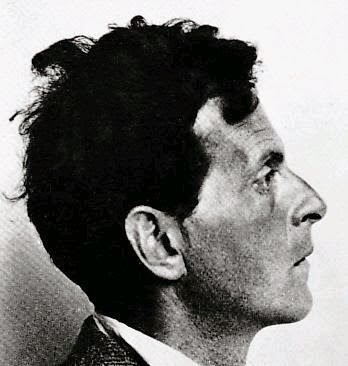
Wittgenstein (uncombed)
The older-wiser Wittgenstein had much critically to say here, most famously in his private-language arguments (most famously in his Philosophical Investigations, §§243-315). His many reductio, from the Investigations and elsewhere, show just how readily the above theorising goes 'from unobvious nonsense to obvious nonsense' (PI, §464). Wittgenstein exhorts us to de-metaphysicalise, 'to bring words back from their metaphysical to their everyday use' (PI, §116). We need therefore to de-concretise the abstractions and de-literalise the metaphors. We need to put the question marks much deeper down than we have done (Culture and Value, p. 62).
'There are propositions of which we may say that they describe facts in the material world ... There are on the other hand propositions describing personal experiences ... At first sight it may appear [...] that here we have two kinds of worlds, worlds built of different materials: a mental world and a physical world. The mental world in fact is liable to be imagined as gaseous, or rather, aethereal. But let me remind you here of the queer role which the gaseous and the aethereal play in philosophy—when we perceive that a substantive is not used as what in general we should call the name of an object, and when therefore we can't help saying to ourselves that it is the name of an aethereal object.' (Blue and Brown Books, pp. 46-7; cf. Zettel §482).
But an experience isn't an object. 'It's not a Something, but not a Nothing either!' (PI, §304). To objectify an experience is to concretise an abstraction. And such objectification is problematic for theorists, insomuch as there isn't an exact symmetry between the logic of objects and that of experiences. If experiences were objects then it would be alright to say that we have access to them. But they aren't, and we don't. (To be in pain, say, isn't literally to have access to anything, neither directly nor indirectly.) If a pain were an object, an intramental object-relatum, then it would be alright to say, 'Logically, you can't have my pain.' But it isn't, and it isn't.
' "Another person can't have my pains." My pains—what pains are they? What counts as a criterion of identity here? Consider what makes it possible in the case of physical objects to speak of "two exactly the same": for example, to say, "This chair is not the one you saw here yesterday, but it is exactly the same as it."
     In so far as it makes sense to say that my pain is the same as his, it is also possible for us both to have the same pain. (And it would also be conceivable that two people feel pain in the same, not just the corresponding, place. That might be the case with Siamese twins, for instance.)
     I have seen a person in a discussion on this subject strike himself on the breast and say: "But surely another person can't have THIS pain!" The answer to this is that one does not define a criterion of identity by emphatically enunciating the world "this." ' (PI, §253).
We can experience the very same experiences—Deus gratia—feel the same feelings, believe the same beliefs, enjoy the same pleasures, endure the same pains, and so on. Note that although objective sameness is numerical or qualitative, experiential sameness is neither. (Compare chromatic sameness. Suppose two men had matching pocket-squares of red. Would it be right for them to say to each other, 'YOU can't have THIS red'? [Cf. BB, p. 55.])

What of the epistemic-privacy worry, that we can't really know what anybody else is (e.g.) thinking? Wittgenstein stands that on its head: 'I can know what someone else is thinking, not what I am thinking' (Philosophy of Psychology, §315).
'In what sense are my sensations private? "Well, only I can know whether I am really in pain; another person can only surmise it." In one way this is false, and in another nonsense. If we are using the word "know" as it is normally used (and how else are we to use it?), then other people very often know if I'm in pain. "Yes, but all the same, not with the certainty with which I know it myself!" It can't be said of me at all (except perhaps as a joke) that I know I'm in pain. What is it supposed to mean, except perhaps that I am in pain?' (PI, §246).
See, 'one says "I know" where one can also say "I believe" or "I suppose" ' (PP, §311). 'Doubting and non-doubting behaviour: There is the first only if there is the second.' (On Certainty, §354). Thus, where it makes sense to speak of knowing, it also makes sense to speak of not knowing—and here it does not.  Where certain knowledge is intelligible, uncertain acquaintance and outright ignorance are also intelligible—and here they are not. (Consider 'I don't know if I'm in pain, let me check,' 'I believed I was in severe pain, but I was mistaken,' etc.)
'Someone who remonstrates with me that one sometimes does say "But I must know if I am in pain!", "Only you can know what you feel," and similar things, should consider the occasion and purpose of these phrases. "War is war" is not an example of the law of identity, either.' (PP, §311).
'When you say, "I grant you that you can't know when A has a pain, you can only conjecture it," you don't see the difficulty which lies in the different uses of the words "conjecturing" and "knowing." What sort of impossibility were you referring to when you said that you couldn't know? Weren't you thinking of a case analogous to that when one couldn't know whether the other man had a gold tooth in his mouth because he had his mouth shut? Here what you didn't know you could nevertheless imagine knowing; it made sense to say that you saw that tooth although you didn't see it; or rather it makes sense to say that you don't see his tooth and therefore it also makes sense to say that you do. When on the other hand, you granted me that a man can't know whether the other person has pain, you do not wish to say that as a matter fact people didn't know, but that it made no sense to say that they knew (and therefore no sense to say that they don't know). If therefore in this case you use the term "conjecture" or "believe," you don't use it as opposed to "know." That is, you did not state that knowing was a goal which you could not reach, and that you have to be contented with conjecturing; rather, there is no goal in this game.' (BB, pp. 53-4). 
To be continued.