They say there was a time when artists were simply artisans. Nobody cared very much about an artist's name, background, upbringing, personality, appetites, political views, chest measurement, hat size. What did all of that matter, so long as the artworks were good? We don't ask after the personal minutiae of other hirelings, do we? That was back then. (And already by classical times artists had become names.) Nowadays we're at the other extreme. What does it matter if an artwork is good? (And what does 'good' mean anyway? Hah!) All that matters is a name, famous or infamous. An artist may exhibit a bag of garbage so long as he has a name. (However, that bag of garbage may be thrown out by the night cleaner—a truly newsworthy story.) Well, 'good' means what it has always commonsensically meant. And it is time that we put again some distance between the artist and his artwork, though not too much.
All too often we say that bad artworks are good, because we take the artists themselves to be good, not qua artists, but in some other way. Then we say that good artworks are bad, because we take the artists to be bad, not qua artists, but in some other way. Tsk, tsk. We may be ashamed of an artwork's parenting, of its birthplace, its provenance, of the rundown carriage that carried it to us—no matter. The artwork is its own standalone thing. How it came cannot change what it is (ex post facto). And if we can't see the what for the how, for the wherefrom, then so much the worse for us. Yes, if you're looking at a painting in a gallery, and a fellow gallerygoer tells you of the painter's turpitude, that he was vicious qua man (though virtuous qua painter), then what you see will probably change, though that at which you look is unchanged. And that's OK. We're not superobjective thingamabobs, after all. But don't let's visit the sins of the father on his children. Don't let's go searching for what isn't there, lest we find it, as hypochondriacs find diseases, diseases that aren't there but may as well be. (Wagner's 'Gesamtkunstwerks,' for example, have been constantly maltreated in this way.)
Note: The 'genetic fallacy' is the go-to fallacy these days. It's a real workhorse. For example, biological taxonomy is now phylogenetical, rather than morphological, and so genetic fallacies run roughshod over it. (Some Animalia are classed as Plantae, etc.) Moreover, Darwinists are forever telling us that we're really no greater than other animals. Why? Because we all have common ancestries and we all came by way of natural selection on random genetic mutation! But what we have here is another textbook genetic fallacy. Suppose the evolutionary anthropologist's just-so story is true, the story about humankind's wherefrom and whereby. Do we then become something other than what we here and now are (viz., rational animals)? Is phylogenesis morphology? Is efficiency formality? No, no, no.
Tuesday, 13 August 2013

Tippy ...
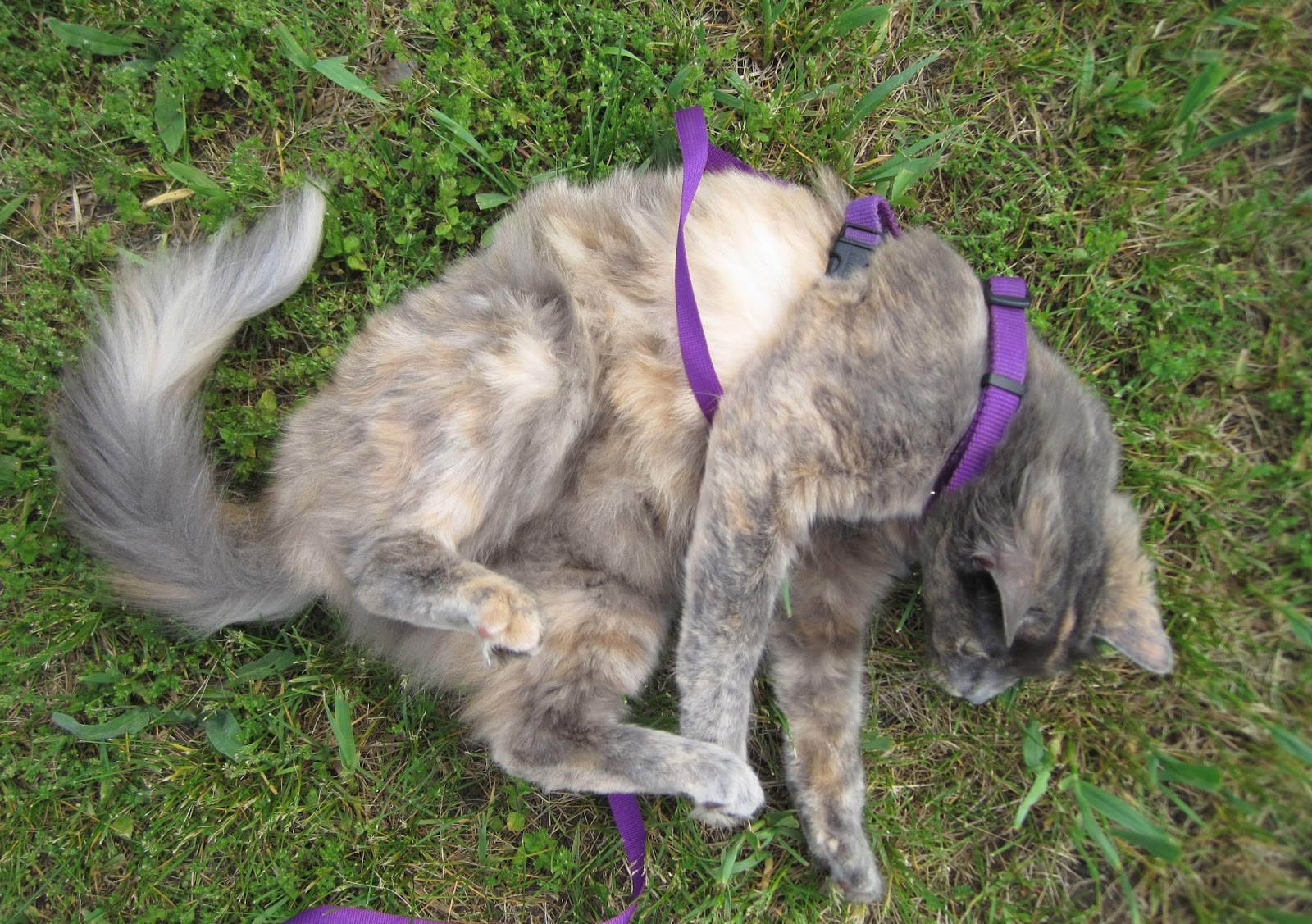 |
| Tippy (who won't be leashed for walkies nohow) |
UPDATE (Aug. 15): Yesterday Tip-tip was still immobile and inappetent. I was worried about dehydration and made her drink from a dropper. She seemed glad of it too — so why wouldn't she drink by herself? Then today I found an ugly bump on her underbelly. Was it a parasite? Off we went to Hillcrest Animal Hospital. Tippy had no fever, they said, and the bump was simply an abscessed wound. They cleaned it up, prescribed antibiotics, and said, '$200 please.' Now we're home and she's sleeping. Let's hope that's all it was. We'll see.
UPDATE (Aug. 16): That's all it was. (Leastwise she's eating and drinking normally now.)
Sunday, 11 August 2013
Apprenticeship ...
 |
| Schönberg |
(Side-note: We stress 'critical thinking' overmuch today, teaching students to talk back before they've really listened. Result: they criticise chimeras. Damnant quod non intelligunt. Look at the army of undergraduates fighting for 'rights,' human, animal, and even vegetable. Now try to find one among them who knows what a right is. If they'd had any sort of colloquy with tradition then they'd know that most 'human-rights violations' that come before the tribunals violate no human right, and that a brute animal cannot in principle be a rightholder. But they don't want first to listen to tradition. That comes late or never. No, the first thing is to strike! [At what? The chimera.] Well, well. To these weathercocks we may say: Welcome to a conversation that's been going on for thousands of years. Glad you could come. Sit and listen for a time. If you feel the need to speak, listen harder. Then, if you still have something to say, do so, but let the elders go first, the longtime listeners, as did Elihu, and prepare to be corrected, as was Elihu.)
 Lately I've been returning to Schönberg's essays. What memories are here! They make me long for another trusting student-teacher relation. Some ask why I don't go back to school for a graduate degree. But college was for me just a long and expensive review that I didn't need (and that I'm still paying for). I'm in no hurry to go back. What I would really like is to find an old master with whom to study, maybe as a live-in. A sort of apprentice-manservant, yes, that's what I'd be. We'd live somewhere out of the way in Europe. Probably I'd have to learn German, elsewise to remember my boyhood French, s'il vous plaît. I'd make his tea, bicycle to the shops for him, feed the cat, do whatever needs doing. And he'd teach me advanced composing ἀρετή: how to deal justly with each note, how temperately to keep away from 'too-ness,' and so on. Most afternoons would find us at the café, going over our present scorework. Then there'd be long walks and longer talks. Cigars. Claret. Sometimes we'd go to church, analysing chorales in the hymnal, 'fixing' them if need be. (This I do already. It's not really vandalism is it? Anyway, I use a pencil. And I leave the book better than it was before.) Sigh. It's a daydream anyhow.
(Side-note: We stress 'critical thinking' overmuch today, teaching students to talk back before they've really listened. Result: they criticise chimeras. Damnant quod non intelligunt. Look at the army of undergraduates fighting for 'rights,' human, animal, and even vegetable. Now try to find one among them who knows what a right is. If they'd had any sort of colloquy with tradition then they'd know that most 'human-rights violations' that come before the tribunals violate no human right, and that a brute animal cannot in principle be a rightholder. But they don't want first to listen to tradition. That comes late or never. No, the first thing is to strike! [At what? The chimera.] Well, well. To these weathercocks we may say: Welcome to a conversation that's been going on for thousands of years. Glad you could come. Sit and listen for a time. If you feel the need to speak, listen harder. Then, if you still have something to say, do so, but let the elders go first, the longtime listeners, as did Elihu, and prepare to be corrected, as was Elihu.)
 Lately I've been returning to Schönberg's essays. What memories are here! They make me long for another trusting student-teacher relation. Some ask why I don't go back to school for a graduate degree. But college was for me just a long and expensive review that I didn't need (and that I'm still paying for). I'm in no hurry to go back. What I would really like is to find an old master with whom to study, maybe as a live-in. A sort of apprentice-manservant, yes, that's what I'd be. We'd live somewhere out of the way in Europe. Probably I'd have to learn German, elsewise to remember my boyhood French, s'il vous plaît. I'd make his tea, bicycle to the shops for him, feed the cat, do whatever needs doing. And he'd teach me advanced composing ἀρετή: how to deal justly with each note, how temperately to keep away from 'too-ness,' and so on. Most afternoons would find us at the café, going over our present scorework. Then there'd be long walks and longer talks. Cigars. Claret. Sometimes we'd go to church, analysing chorales in the hymnal, 'fixing' them if need be. (This I do already. It's not really vandalism is it? Anyway, I use a pencil. And I leave the book better than it was before.) Sigh. It's a daydream anyhow.
Sunday, 28 July 2013
1,000 hours ...
On Friday evening I went to hear the Toronto-based 'Tokai' string quartet. It was the fourth or fifth time that I've heard them, and they always play well. This time we had Purcell, Britten, Dvorak, and also a brand new work, commissioned—heaven help us—by the Art Council of Ontario. It was a formless succession of scraping willy-nilly and scratching hitty-missy. The composer had simply thumbed through the catalogue of special effects, from A to Z, and written them in as they came. There were openhand violin slaps, and savate strikes to the body of the cello. ('Let's report them for cruelty to instruments,' whispered my companion afterwards.)
Hackwork makes me fidgety. I can't then be patient with my own life-task. And I say to myself: Alright I'm no master, but I can do far better than that. (Plus, the Art Council's $6,775 would do me material good, wretched indigent that I am, living on weak tea and sawdust.) But, then, I'm not ready. Yes, I can here and now write music in most any historical style, from academic fugues with crab-canons to sugarsweet salon romanzas, and even rigorous serial works. But to step out of history and into the present—no, I'm not ready. For I, too, live with the unanswered 'what now?' that troubles so many. (But more on that later.)
And there's so much to do. And it's easy for me with my singlemindedness to be altogether taken up with asides (literature, philosophy, whatever). My time needs governance. I need to spend as much time reading scores as I do books. It's not much, but I've determined to log 1,000 hours of study in the next twelve months. See, here's a moleskin logbook to make it official. To work!
Hackwork makes me fidgety. I can't then be patient with my own life-task. And I say to myself: Alright I'm no master, but I can do far better than that. (Plus, the Art Council's $6,775 would do me material good, wretched indigent that I am, living on weak tea and sawdust.) But, then, I'm not ready. Yes, I can here and now write music in most any historical style, from academic fugues with crab-canons to sugarsweet salon romanzas, and even rigorous serial works. But to step out of history and into the present—no, I'm not ready. For I, too, live with the unanswered 'what now?' that troubles so many. (But more on that later.)
And there's so much to do. And it's easy for me with my singlemindedness to be altogether taken up with asides (literature, philosophy, whatever). My time needs governance. I need to spend as much time reading scores as I do books. It's not much, but I've determined to log 1,000 hours of study in the next twelve months. See, here's a moleskin logbook to make it official. To work!
Odi et amo ...
Things I love: old churches, good penmanship, a day's first espresso, T.T.'s impastos, Mozart in the forenoon, Chopin at even, (the greater light to rule the day, the lesser light to rule the night), slow food, realising that I've only made two half-pots of coffee (therefore: a third is forthcoming), faraway train whistles on summer nights, driftwood, open-air theatre, cigar smoke, the dear-old Greeks, wine at gloaming, the unauthorised poet ...
Things I hate: dribblesome carafes, a hasty disowning of the past, T.E.'s installations, myself, bad intonation, fast food, loudmouths (remember: empty barrels make the biggest sound), hypochondriacal foresuffering, pre-ground supermarket coffee (also called dirt or sod), reductionisms, plastic, television, muzak ...
Things I hate: dribblesome carafes, a hasty disowning of the past, T.E.'s installations, myself, bad intonation, fast food, loudmouths (remember: empty barrels make the biggest sound), hypochondriacal foresuffering, pre-ground supermarket coffee (also called dirt or sod), reductionisms, plastic, television, muzak ...
Saturday, 27 July 2013
Both beautiful AND ugly? ...
 |
| The Philosopher |
But first a high-speed run-through. Ex hypothesi, beauty is a transcendental, standing alongside truth and goodness—that is to say, it is something over and above the genera, supra-categorical. (Whence the fact that beauty finds its way into all ontological categories: concretes and abstracts, subjects and objects.) And being modes of being (or Being), the transcendentals are interconvertible. But how can such very different things—truth, goodness, and beauty—interconvert? The answer (ex hypo.) is that they are not as different as they seem. Consider an analogous case from the philosophy of logic. Necessity, analyticity, and apriority are separate notions. But they all look at the same thing from different viewpoints: those of metaphysics, semantics, and epistemology. To use the Fregean jargon, they differ in sense but not in reference. And so it is with the (similarly coextensive) transcendentals.
Ye be warned: the terms are used extendedly. For example, truth is not here to be understood propositionally, not as a "truth-value," but rather as realness or genuineness. (Truth with an uppercase "T".) For classical thinkers, both Platonists and Aristotelians, something is true insofar as it is an exemplar. The triangle drawn with a straightedge is truer to triangularity than that drawn freehand. A tree with a strong root-system is truer to treeness than a root-fallen tree. Etc. Further, the well-drawn triangle is good, whereas the poorly-drawn triangle is bad. A strong-rooted tree is good, whereas a weak-rooted tree is bad. Turning to mankind, trueness and goodness finally comprehend morality. The virtuous man is more true and more good than the vicious man. So if you want to be a real man, a manly man, then be virtuous. (Why do the classical philosophers use the terms so oddly? They don't—we do.)
Anyway, it follows from all the above that if something is beautiful, it must thereby be true and good. But most find this troubling. Roger Scruton, in his wise—if overmuch Kantian—book on beauty, writes the following (about Aquinas specifically):
If that [A-S transcendentalism] is so ... how can there be dangerous beauties, corrupting beauties, and immoral beauties? ... I don't say that Aquinas has no answer to those questions. But they illustrate the difficulties encountered by any philosophy that places beauty on the same metaphysical plane as truth, so as to plant it in the heart of being as such.Here Scruton puts forward the most common objection to the A-S philosophy of beauty. And it seems to me rather weak, even point-missing. After all, what the traditional thinkers are saying, using the terms in the traditional ways, is that just insofar as a thing is beautiful, it is true and good. Take, say, a beautiful sophism—more correctly, a beautifully-phrased sophism. Objectors will say, 'Look, here's something beautiful that's also false and bad. So there!' Well, yes, but really we are talking about two things. For just what is it that's beautiful? Answer: the phraseology. And insofar as it is beautiful, it is true and good. What is it that's false and bad? Answer: the sophism. And insofar as it is false and bad, it is ugly. Put it this way. The beautifully-phrased sophism is both beautiful, re its form, and ugly, re its matter. (And there is always some such multiplicity in these cases.) Ergo there is no contradiction.
 |
| Socks |
Note: nothing here calls for a substance dualism or treblism. It is enough that the analysanda be separable in some way, not necessarily ontologically.
If it turned out that something good was eo ipso ugly, or that something bad was eo ipso beautiful, then goodbye transcendentalism. But I can't see how such a thing would be at all possible. Can you?
If it turned out that something good was eo ipso ugly, or that something bad was eo ipso beautiful, then goodbye transcendentalism. But I can't see how such a thing would be at all possible. Can you?
Sunday, 2 June 2013
Soul—atoms ...
 |
| Leucippus |
 |
| Democritus, the chortler |
Subscribe to:
Posts (Atom)